Sunday, August 15, 2010

Piping and Highland Dancing in Pictou


We spent the day in Pictou attending the Hector Festival on the "quay." The Hector was the ship that brought the first Scottish settlers to Nova Scotia in 1743. Each year the town celebrates this historic event with a three day festival of concerts and many "ceilidhs," gaelic for parties! Before the piping concert we shopped in the farmers market where I met some fellow labs, both black and brown. Mom bought some treats for gradnson Marcus, and then we strolled down to the festival. Dad describes the events:

" The afternoon started with a very impressive procession of bag pipers and drummers from the Canadian military. Then we had two more bagpipe concerts with a grand finale of pipers and dancers who regaled us with a number of highland dance routines. Highland dancing is different from the Irish jiggers. The highlanders do more of a ballet step, with hands held high, and then graceful twirls and bows. So there's something about bag piping; after the fifth band, Jasmine agreed that enough already.

But it was all very festive and authentic!"

Pictou is another picturesque town with lots of history, and quaint buildings and parks along the harbor. Mom and Dad chatted with some of the locals, some of whom were fifth and sixth generation Pictouians.

Our campgrounds overlook a beautiful Bay with a spectcular sandy beach. I romped in the surf, chasing tennis balls for over an hour. Mom braved the figid water for just about a minute, but she almost got in all the way. Dad staid back for photos.Whimp!

Tomorrow we board the ferry for Price Edward Island. Can't wait!

Saturday, August 14, 2010

From Port Hood to Pictou


We had a lovely day in Port Hood on the South Western coast of Cape Breton Island. We stayed in a campground called Sunset Sands, and based on the fantastic sunset, it's well named. I had a blast cavorting in the surf, while Mom and Dad watched the PGA tournament on Dad's computer (PGA.Com has live video feeds!) Today we wound our way down the coast toward Pictou, a medium sized town where the ferry departs for Price Edward Island. We're taking the ferry on Monday. On our way, we stopped in a small village called Arisaig; very much an old gaelic settlement. Dad struck up a conversation with a local who was just about to go out fishing for mackeral. (see photo) His name was Bill Cottie, and he said that his ancestors first arrived in North Carolina in the 1700s from England. Being loyalists to the crown, they fought against the colonialists in the Revolutionary War. Once the war ended, they migrated to Nova Scotia to escape the wrath of the liberated Americans. So Bill was a fourth or fifth generation settler in Nova Scotia.

Arisaig is another one of those magical little settlements with a tiny harbor, lighthouse, fishing boats and a few rustic looking buildings nestled around the small harbor.

We then left for Pictou, where our campground is about 5 miles east of town. We've settled in for the day. Tomorrow we visit the local Hector Heritage Quay Museum which details the early arrival of the Scottish immigrants in 1733. Apparently a boat load of Scotts including 33 families and 25 unmarried men arrived on the schooner, The Hector, in 1733. They were piped into town, and became the first scotts to arrive in Nova Scotia. Today the scots represent 60% of Nova Scoltia's population. We plan to inspect a replica of the Hector during our museum visit. We also hope to attend the Hector Festival which celebrates the arrival of the scottish immigrants with concerts , Celtic dancers, and lots of food and drink.

Friday, August 13, 2010

Conquering the Cabot Trail


We just spent the last few days winding our way around the famous Cabot Trail through Cape Breton National Park. This is some of tghe most spectacular scenery in North America if not the world. The highway snakes around cliffs and mountains providing awesome vistas of valleys, rivers, forests, and the Atlantic in the distance. It took us the better part of a day to make the trek, ending up last night in Port Hood, a beautiful beach side camp ground on the western shore.

One of the highlights of the trip was a visit to a small fishing village on the North Western coast of Cape Breton- Neils Harbor (see photos) Here we found a small lighthouse, tiny harbor with a few lobster boats, and a wonderful little restaurant perched on rocky point called the Chowder House. Dad had the fish chowder which was brimming with lobster, clams, haddock, and scallops...to die for. Mom had the chowder too and said it was unbelievable.

Yesterday Mom and Dad played a round of golf with the Kings in Ingonish at the world famous Highlands Links course rated as one of the top golf courses in the world. Dad said that this was the most beautiful course he's ever played, with breathtaking views of the mountains on one side, and the Atlantic ocean on the other. A Pete Dye designed course, the fairways undulated with steep hills, and blind shots to the greens. The Bells and Kings had a blast, celebrating their last night together with a dinner near the camp site.The Kings are off to visit Linda's daughter and family way up in the Gasbay peninsula near the St Lawrence Seaway. We had a wonderful time with the Kings, and I really enjoyed frollicking with Enzo and Becky. I have to admit a bit of homesickness for Oak Island and all my buddies
back home.

Today Mom and Dad toured the Glenora Distillery near our camp site in Port Hood. This is the only single malt whisky distillery in Nova Scotia...their signature whisky, the Cape Breton, was delicious but potent, so says Dad.

Tomorrow we're off to Pictou on the northern coast just before we leave for Prince Edward Island on Monday

Tuesday, August 10, 2010

The Louisberg Fort and The Alexander Graham Bell Museum


We camped right next to the famous historical restoration of the Louisberg Fortress on the Northeastern Coast of Cape Breton Island. I basically spent the day asleep, but Mom and Dad toured the fort. Dad's report:

Louisberg was initially built in 1713 by the French as one of their first North American outposts. The city was entirely surrounded by ramparts defended with cannons. Unfortunately the British over-ran the fortress in 1746, and subsequently deeded back to the French in 1756 in exchange for other lands in Nova Scotia. The Brits main fortress was in Halifax. The French finally subcombed to a lack of trade and the colony folded in 1765. In the 1960s the Canadian government undertook a massive reconstruction of Lewisburg as a way to give employment to the local miners who suffered from a shut down of the mines. The fortress includes all kinds of buildings, ramparts, governor's mansion, and vaious french style homes for the local constabulary. A separate large building housed the fort's garrison. At its peak, Louisberg had a population of 7000. The complex is staffed with several dozen citizens dressed up in period costumes (see photos) we had a great guided tour (Louisa Johnson- she's the buxom lady in the photo)) who animated the tour with great stories of life in the 18th century Louisberg. For example we learned that the troops slept three to a bunk, bathed only once a year and suffered freezing temperatures in the winter and stifling heat in the summer. The stench was so bad that the local indians refused to come into the fort because of the smell. We watched several military exersizes including the firing of the cannons from the ramparts. All very interesting and entertaining.

Today the Bells and Kings toured the Alexander Graham Bell museum in Baddeck (pronounced Ba- DECK') As a distant relative I learned much about Dr. Bell I didn't know. For example did you know that Bell invented a version of the airplane that lagged the famous Wright Brothers flight by 6 days? He invented a hydrofoil boat that could reach speeds of 70 miles an hour. He invented the first prototype of the iron lung. He also invented a better version of the phonograph that outperformed the Edison version. Descendants of the Bells still live in his mansion overlooking the lake near Baddeck. Quite an amazing inventor /scientest! His wife, Mable was also an extraordinary woman who managed the Bell estate and fortune.

We're off to the Cabot Trail around the northern tip of Cape Breton island tomorrow!

Sunday, August 8, 2010

Adrenelin Rush in the Tidal Bore


After Lunenberg and the "ovens," we traveled up the Acadia coast (eastern coast of Nova Scotia) to the lovely village of Digby. Here the Bells and Kings biked down an abondoned railroad track into town for dinner and a rock concert on the village green. Unfortunately the concert was quickly scuttled by a rain storm. The next day the Kings and Bells played golf at a beautful mountainous course which is part of the Digby Pines Resort. The next day we traveled on, passing through Anapolis Royal. What a beutiful village that was bustling with a farmers market, and regaled the villagers with a band concert. From Anapolis Royal we finally arrived in Brookfield near Maitland at the very eastern end of the Bay of Fundy. Along the way Mom and Dad stopped into a winery, the Muir Winery. We bought a white and a red. That night the Bells and Kings feasted on lobster and then the next day (today) we all motored over to the River Rafting adventure near Maitland.

I'll let Dad describe the tidal bore adventure:

"So we rose early to arrive at the rafting place by 8:00 AM. The tidal bore is a series of enormous rapids that result from the rushing inflow of the Bay of Fundy tide. We motor out in 16 foot Zodiacs powered by a 60 HP Mercury outboard. There were 8 rafts with six people to a raft. The Kings and Bells shared a raft with two intrepid ladies from Indiana- Linda and Anna Gale. Our raftsman was named Kurt, who was an aspiring culinary student and chef in his off months. We traveled about 6 miles up the Shubernacadie River, that runs south from the end of the Bay of Fundy. Because the river acts like a funnel the tide rips into the river like a freight train rising more than 25 feet in a matter of minutes. This produced huge rapids with waves that exceeded 12 feet at times. The raftsman steered up the river with the tide into the teeth of these huge waves. The sensation is one of a sardine in a Cuisinart. We gripped the lines along the gunwale and leaned in with terror as the tiny raft lunged up and down in the maelstrom. We entered what Kurt called the Deadly K and the Eagles Nest. These were two rapids that produced the highest and most ferocious waves. After the third terrifying run through these rapids, we agreed that enough was enough. Needless to say we were soaked, even though we wore foul weather gear and boots. Arriving back at base camp we all showered and enjoyed a cup of hot chocalate. What an adventure! Here's their web site for shots of the adventure: http://www.tidalborerafting.com

Tommorrow we're off to Louisburgh on the Southeastern coast.

Friday, August 6, 2010

Livin It Up in Ludenberg


We spent several days near Ludenberg on the Southern Coast. Ludenberg is a classic old shipping town, and designated as only one of two World Heritage sites in North America by UNESCO. The town is laid out in a classic English village configuration with neat rows of avenues and streets defining the neighborhood. The Bells and Kings toured the maritime museum which highlighted the famous fishing schooner Bluenose II. The original Bluenose won virtually all of its races against the US fishing schooner from Glouster. It was eventually sold to the East Indian trading Company and was scuttled on a reef in the Bahamas. Bluenose II is an exact replica and now is in dry dock for a two year restoration.
We stayed at a camp ground known as “the ovens.” The ovens are a series of caves along the rugged coast. Back in the 1890s, gold was discovered here, and a small town erupted over night. About 120,000 pounds of gold was extracted until the claims went dry. We bumped into a family panning for gold, and they showed us their findings, tiny specks of gold! We had a great camp site overlooking the ocean. The next day we toured Blue Rock, a tiny fishing village some ten kilos from Ludenberg. What a gem! Small, multicolored, houses encircle the tiny harbor featuring classic trawlers and sailboats at their moorings.

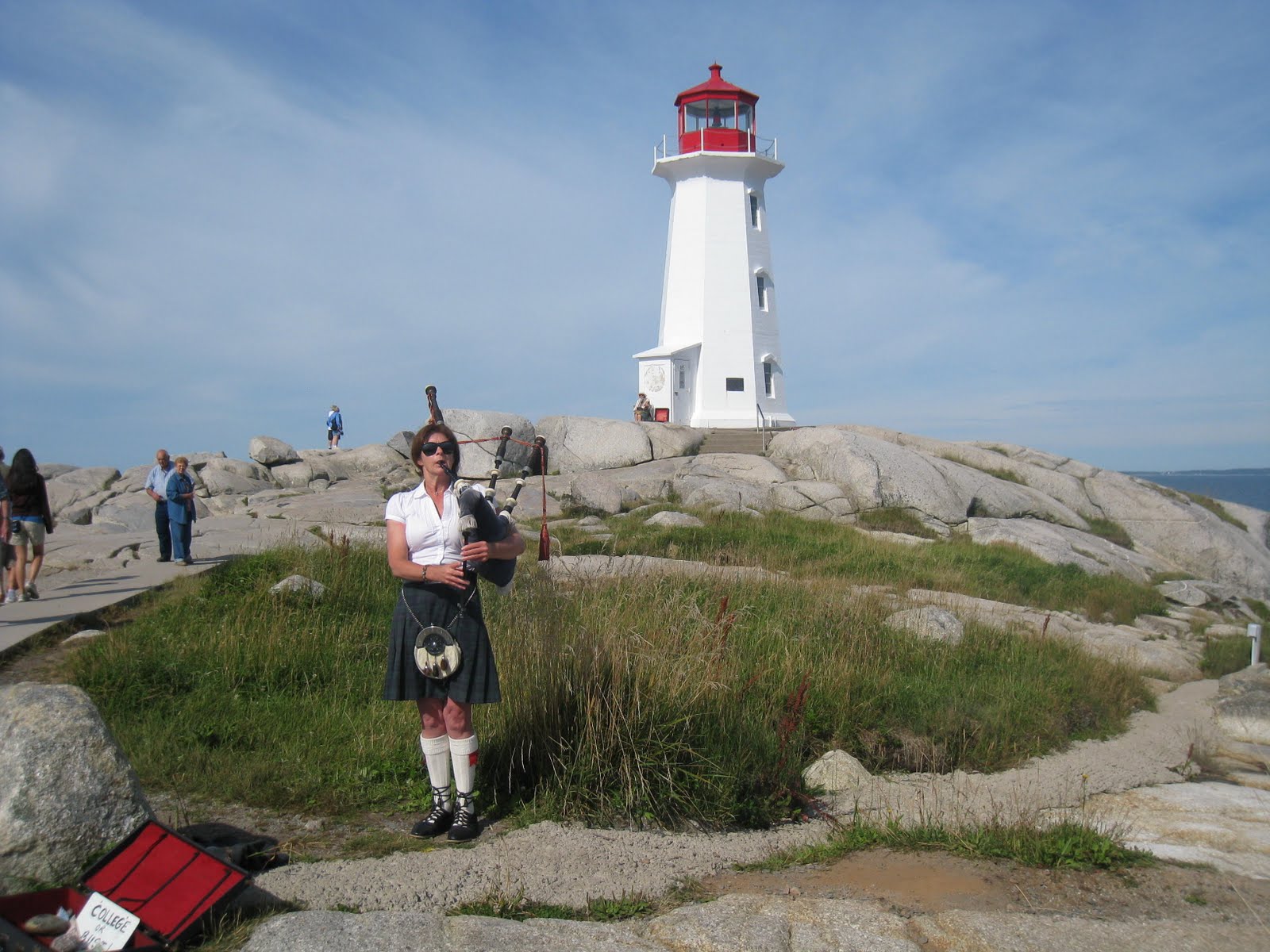
Earlier we stopped at Peggy’s cove which features the most famous lighthouse in Nova Scotia. Out in front of the lighthouse was a young lassie in a kilt playing a bag pipe.

On the way to Digby we stopped to check out the largest wooden church in North America. Built in the early 1800s, the church is huge rising to 60 feet inside. (see pic)

We’re now in a camp ground close to the town of Digby located at the mouth of the Bay of Fundy. The Kings and Bells biked in for dinner and then attended a rock concert in the village green. After about an hour, it began to pour, so the Bells scurried back to the camp. The kings hung in there and danced away for another hour in the rain.

The food has been spectacular. Last nigh the Bells feasted on Haddock and Salmon. The Kings enjoyed the famous scallops of Digby. We've also been pigging out on Mussels and Lobster

Today the Bells and Kings play a round of golf. Tomorrow, we’re off to Maitland at the end of the Bay of Fundy. The Kings and Bells plan a rubber raft ride in the Bay of Fundy riding the famous flood tide back into the bay. They say the ride endures fourteen foot waves. I say “good luck.”

Tuesday, August 3, 2010

Halifax is Hopping


We spent two days near Halifax and toured all the sites. On Sunday we checked out the famous Citidel on top of a hill overlooking Halifax Harbor. This is huge eight sided fortress that has been rebuilt four times since the late 1600s. The walls are so formidable and the moats and gun placements so daunting that the fort never succombed to an attack. Mom and dad watched troops in fine highlander uniforms do close order drill and rifle firings (very loud!) Next, Mom and Dad along with Dick and Linda King checked out the board walk along Halifax harbor. There were several Canadian ships moored along the quay that were interesting.

Yesterday, Mom and Dad toured the cemetary where several hundred victims of the Titanic were buried. Halifax was the entry point for Titanic victims, many of which were unidentified, and buried in an unmarked grave. The survivors were taken directly to New York on the steam liner Capathia. All very sad.

Mom and Dad also toured the maritime museum which told the horrific story of the great explsion of the late 1800s. A British frigate loaded with explosives was rammed by another ship. It then caught on fire. The fire raged for hours which attracted a crowd along the quay. Suddenly a huge explosion ripped across the harbor. Over two thousand were killed and thousands more were injured. It was the largest single explosion in the world up to that point, only exceeded by the nuclear detonations in Japan. A 1000 pound anchor was found three miles away. It took years for Halifax to recover. Another interesting fact about Nova Scotia are the ship wrecks. It is estimated that between 10,000 and 25,000 ship wrecks have occured along the coast. The most recent was a provate yacht that crashed into Sable island in 2003.

Mom and Dad also toured the public botanical gardens modeled after the Victorian gardens in London. Mom and Linda were particularly impressed with the enormous pair of geese, which must have been thirty pounds in weight!

Today, we all depart for our next port of call...Ludenberg with several stops along the way. Can't wait!